General information

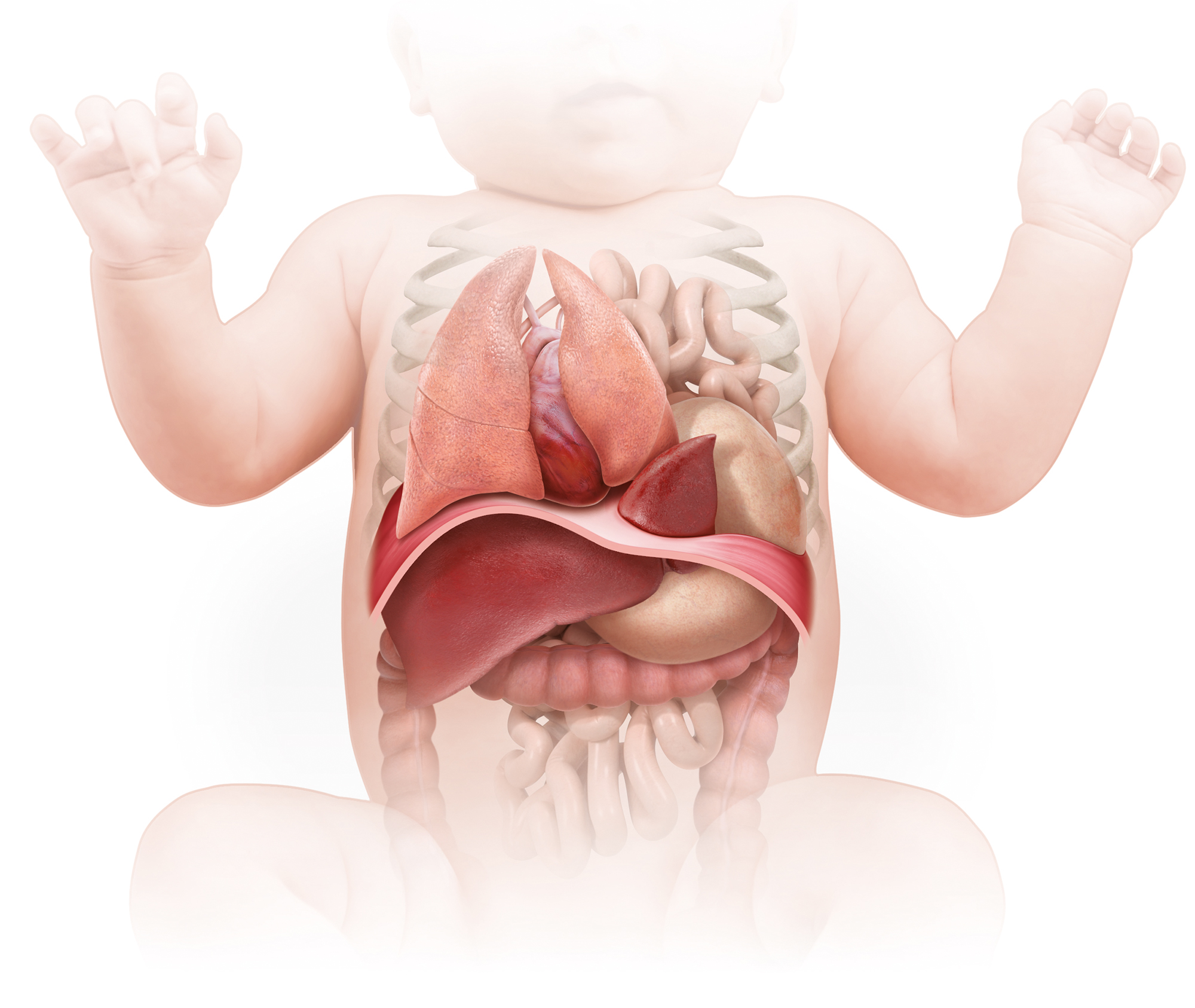
Congenital diaphragmatic hernia (CDH) is a birth defect that occurs when a baby’s diaphragm – a thin sheet of muscle that separates the abdomen from the chest – fails to close during prenatal development. The diaphragm normally develops by around the 10th week of pregnancy. CDH occurs when the diaphragm fails to form correctly, allowing the abdominal contents to move into the chest cavity through a hole in the diaphragm. Depending at what stage of the baby’s development the abdominal contents herniate into the chest, it will determine how much the baby is affected.

Fig. 1. Types of CDH: Bochdalek hernia

Fig. 2. Types of CDH: Morgagni hernia

Usually the stomach, liver, spleen, intestine and sometimes the kidney enter the chest.

Fig. 3. Left-sided hernia

Fig. 4. Right-sided hernia
CDH occurs in approximately 1 in 4,000 live births. The vast majority of babies with CDH have a posterolateral defect on the left side of the diaphragm.